We began in 1846 as a baking soda business. Today, we are a top-tier consumer products company with a large portfolio of brands consumers trust and love, especially ARM & HAMMER®. Since 2022, we have invested more than $700 million in U.S. capital expenditures, primarily to increase manufacturing capacity. Major projects, including new production lines, advanced automation systems, and expanded warehouse capacities, have significantly enhanced operational efficiency and created new jobs. These strategic investments highlight our commitment to the sustainable expansion of U.S.-based manufacturing operations.
We have a rich heritage of commitment to people and have long regarded ourselves as a friend of the environment. Over 100 years ago, we began using recycled materials in our cartons. We were the first U.S. manufacturer to remove phosphates from laundry detergent, and one of the first corporate sponsors of the inaugural Earth Day in 1970.
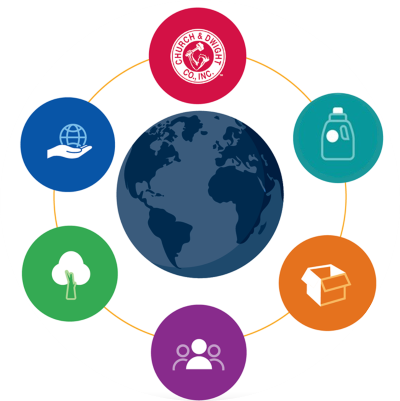
Church & Dwighters are goal-oriented. To guide our Sustainability Program, we have established goals to improve the sustainability profile of our operations and products to benefit our employees, customers, consumers, and communities in which we operate, while supporting strong financial and operational performance. Our priorities include delighting consumers through our brands; delivering safe, effective products; optimizing packaging to reduce costs and improve recyclability; lowering energy and water use to expand margins; minimizing waste and disposal expenses; strengthening ethical, reliable, high-quality supply through our suppliers; and fostering an inclusive culture and responsible citizenship.
We are actively working to increase renewable energy use at our facilities; reduce water consumption, greenhouse gas emissions, and solid waste to landfills; use environmentally responsible packaging; and improve our suppliers’ sustainability practices. In 2025, we continued to procure 100% of the electricity used in our operations globally from renewable sources, including renewable energy credits.
The Science Based Targets Initiative approved our application in 2022. In 2025, our absolute direct emissions from our operated facilities (Scope 1), indirect emissions from our purchased electricity and steam (Scope 2), and targeted Scope 3 emissions, including transportation of finished products to the first point of customer contact in the U.S. and Canada and corporate business travel, decreased by 2% compared to 2024.
We are committed to providing consumers worldwide with high-quality products and ingredients that comply with all safety and regulatory requirements. We have developed a master list of Chemicals of Concern derived from global regulations, scientific reviews by authoritative bodies, and retailer restricted substance lists, and we continuously review product formulations against that list.
We continue to pursue our strategy to minimize our environmental impact by reducing plastic in our packaging wherever practical, consistent with product standards and customer expectations. Our approach includes incorporating non-plastic alternatives, reducing plastic weight, improving recyclability, and increasing the amount of post-consumer recycled (PCR) plastic in our packaging. Our goal is to increase the use of PCR plastic over time. In 2025, rising material costs reduced the availability and increased the cost of PCR materials, resulting in average PCR usage of 20.73% in our plastic packaging, down from 22.9% in 2024. Although we did not meet our 2025 goal, our efforts added 28.5 million pounds of recycled plastic content annually to our packaging.
With more than 5,500 employees across more than 50 locations worldwide, the safety and wellness of our employees remains a top priority. We are also dedicated to maintaining a culture of belonging at Church & Dwight. We support several Employee Resource Groups (ERGs), open to all employees, where all our employees feel connected, valued, and inspired. We embrace diversity in all its dimensions and aspire to build a more inclusive and engaged workforce to support our long-term performance. We are an equal employment opportunity employer and remain committed to fair treatment, access, opportunity, and advancement for all employees based on merit.
We take great pride in fostering an enduring culture of doing well by doing good. We matched, dollar for dollar, donations our employees made to the Church & Dwight Employee Giving Fund (EGF), an employee-run giving program that primarily supports charitable organizations where our employees work and live. In 2025, the EGF supported our communities by providing approximately $1.3 million to 224 community organizations through annual grants, disaster relief, and other monetary support. Additionally, the Church & Dwight Philanthropic Foundation (the “Foundation”) granted $1.1 million in aggregate to 10 organizations. Established in 2020, the Foundation is administered by our employees and focuses on creating educational and employment opportunities and advancing environmental preservation.
In 2025, we received public recognition for our sustainability efforts, including listings in Time Magazine’s Rankings of the World’s Best Companies and the World’s Most Sustainable Companies, Newsweek’s Rankings of America’s Greenest Companies and America’s Most Responsible Companies, the Wall Street Journal/Druker Institute’s ranking of America’s Best Managed Companies, and USA Today’s Ranking of America’s Climate Leaders, among others.
We have made—and will continue to make—meaningful progress on sustainability by prioritizing initiatives that both reduce costs and deliver positive environmental outcomes. As we look ahead, we will remain committed to continuous improvement. Our roadmap is designed to support a stronger, more resilient, and more sustainable company.
Please read this Report to see the progress we have made over the past year to make Church & Dwight an even better company.

Rick Dierker
President and Chief Executive Officer